Decorative 3D figure drawn like a particle-detector event display. Four concentric rings stand for the four research groups, with 22 lit modules, one per research area. 23 curved tracks leave the center, one per project: solid where the project resolves to a public repository, dashed where it is résumé-declared. 46 red bars around the outside are the repositories verified as his own work, sized by commit count. As the page scrolls the figure turns, pulls its layers apart, and moves beside each section. Every value it encodes is written in the page text.
Mansurbek Satarov
I study how AI systems fail and get attacked, and I build the ones that hold.
Ph.D. researcher in trustworthy AI, University of Cincinnati · AI/ML engineer
- 23tracks
- One per project. Solid resolves to a public repository; 2 dashed are résumé-declared.
- 22lit modules
- One per research area, on four rings — a ring for each research group.
- 46deposits
- Repositories verified as my own work, sized by commits authored.
I research how AI systems learn, fail, and get attacked — models and the agents built on them — and I engineer the ML systems, agents, and products that hold up in the real world.
Every claim, checked
Nothing on this site is asserted. A claim is marked verified only where a public, machine-checkable artifact backs it; everything else is labeled self-reported, in plain sight.
Claims on this site
0 of 5 checked
- WorkVerified21 of 23 case studies resolve to a public repository
- Open sourceVerified46 repositories classified as own work from commit data
- PlaygroundVerifiedFive playable systems, each with a pure core under unit test
- ResearchSelf-reportedResearch direction stated; individual work not yet citable
- Self-reportedSelf-reported2 projects are résumé-declared with no public repository
Self-reported is not a failure state. It marks what is declared but cannot yet be confirmed from a public artifact — kept on this list so you know exactly which claims you can check yourself.
22 research areas, four questions
ResearchHow models learn and behave, how to keep them secure and trustworthy, what they are made of, and what changes when they act as agents. Each question is one ring of the detector, pulled apart here.
Training & learning dynamicsring 1 · 4 modules
Safety, security & governancering 2 · 8 modules
Models, modality & efficiencyring 3 · 5 modules
Agentic & retrieval systemsring 4 · 5 modules
RLHF & preference optimization
How preference data and policy optimization shape model behavior.
Training & learning dynamicsHow models learn, and what data, training, and fine-tuning do to their behavior.
Selected work
All 23 projectsResearch systems, agentic pipelines and production ML, each with the architecture that made it work and the results it actually produced.
Multi-Agent Deep Research
A LangGraph supervisor/worker research workflow that plans, gathers evidence, extracts structured findings, and writes sourced reports.Python · LangGraph · OpenAI API
CompleteRetail Intelligence Platform
End-to-end Azure retail analytics: customer lifetime value, churn risk, basket associations, household search, and cached dashboards.FastAPI · React · Vite
CompleteRAG Assistant
A modular retrieval-augmented generation pipeline: ingestion, chunking, embeddings, ChromaDB vector search, and a conversational interface.Python · Flask · ChromaDB
CompleteDinoMind Evolution
NEAT neuroevolution learns to play a dino runner — neural networks evolve generation by generation to dodge obstacles.Python · Pygame · NEAT-Python
CompleteDocuParse
High-performance PDF/EPUB/MOBI → structured Markdown conversion with AI layout detection, LaTeX equation handling, and multilingual support.Python · OCR · Layout-detection models
CompleteDigitRecognizer
A neural network handwritten from scratch in NumPy — forward propagation, backprop, and gradient descent on MNIST, no frameworks.Python · NumPy · Matplotlib
Completevoxide
Offline, semantic voice control for developer workflows: say what you mean, and a local sentence-embedding model maps it to the right command.Rust · Sentence embeddings · Offline speech recognition
Running
Open source, honestly labeled
Open source87 public repositories, each labeled by a relationship computed from commit data. The 46 red deposits are the ones verified as my own work. Forks and stars are listed as exploration and reading — never counted as contribution.
- Own work
- 46
- Forks kept for study
- 41
- Saved references
- 83
- Technologies used
- 61
Own work by domain
- Web20
- Data science7
- Computer vision6
- LLM & agents4
- Cloud3
- Systems2
- Games2
- Other1
- Machine learning1
Bars count repositories the classifier resolved to his own commit history. Forks and stars are excluded from every bar here.
Label definitions
- Built by me
- Owned, not a fork, with a substantial own-commit history.
- Co-built
- Owned, with two or more active co-contributors.
- Contributed
- Someone else's repository, with merged pull requests.
- Forked & explored
- A fork kept for study. Counts as reading, not work.
- Studied / used
- Depended on or read closely, without commits.
- Saved resource
- Starred for reference. Zero contribution claimed.
Things you can play
PlaygroundFive systems that run in your browser. Each has a pure, deterministic core under unit test — the code the tests replay is the code you play.
DinoMind Arena
Race a visualized AI runner over the identical seeded course.
Re-Entry Corridor
Hold the descent inside the corridor on a fixed propellant budget.
Go / No-Go Drill
Read four gauges and call the burn before the clock runs out.
Neural Tic-Tac-Toe
Exact alpha-beta on 3×3, depth-limited search on 3×3×3.
Typing Challenge
Machine-learning terms and real code, scored on live WPM and accuracy.
This site, 4 times
Design historySame facts, same attribution rules, four different worlds. Each earlier design is kept as a capture from the commit that shipped it.
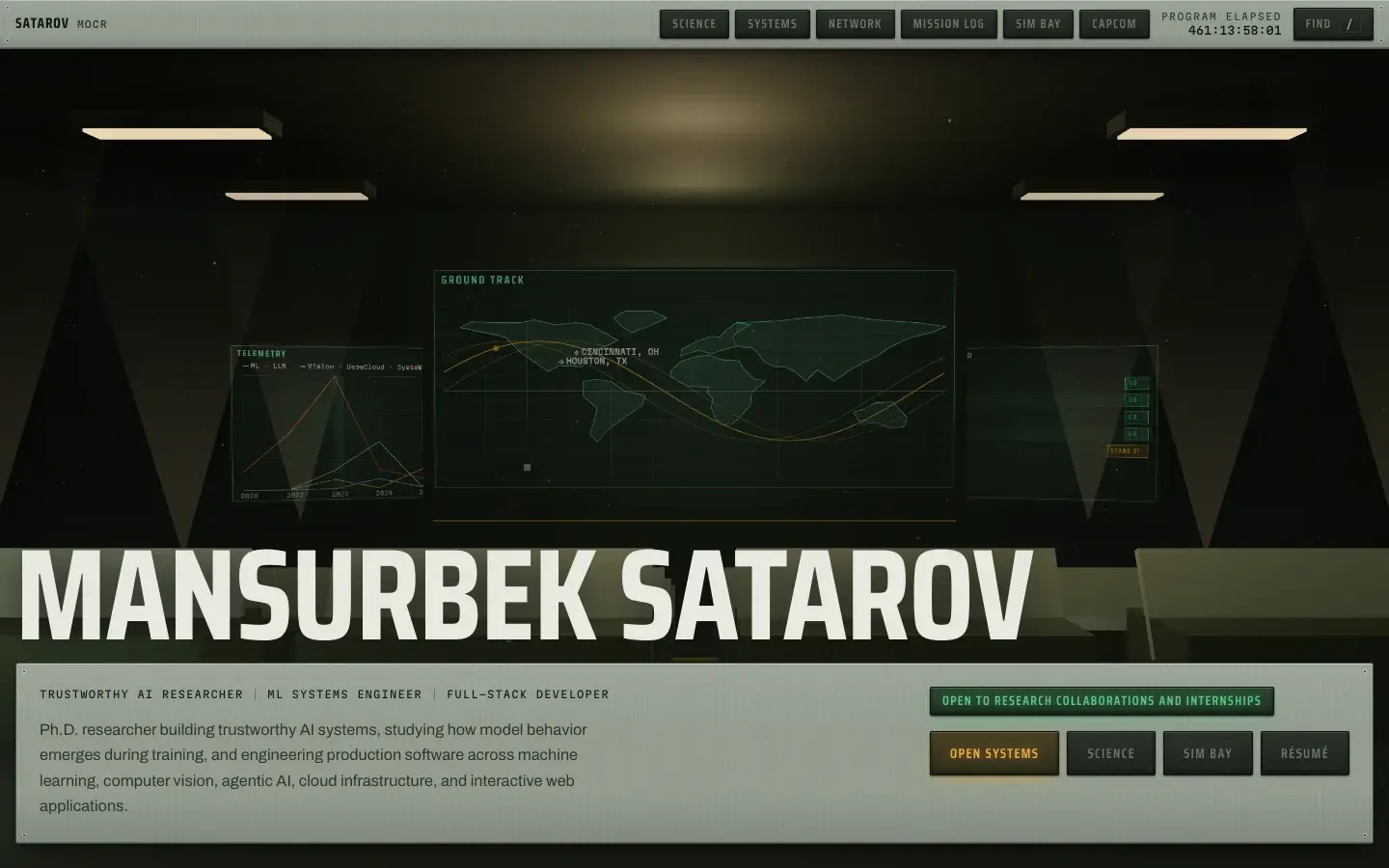
Flight Operations
v1 · 2026-08
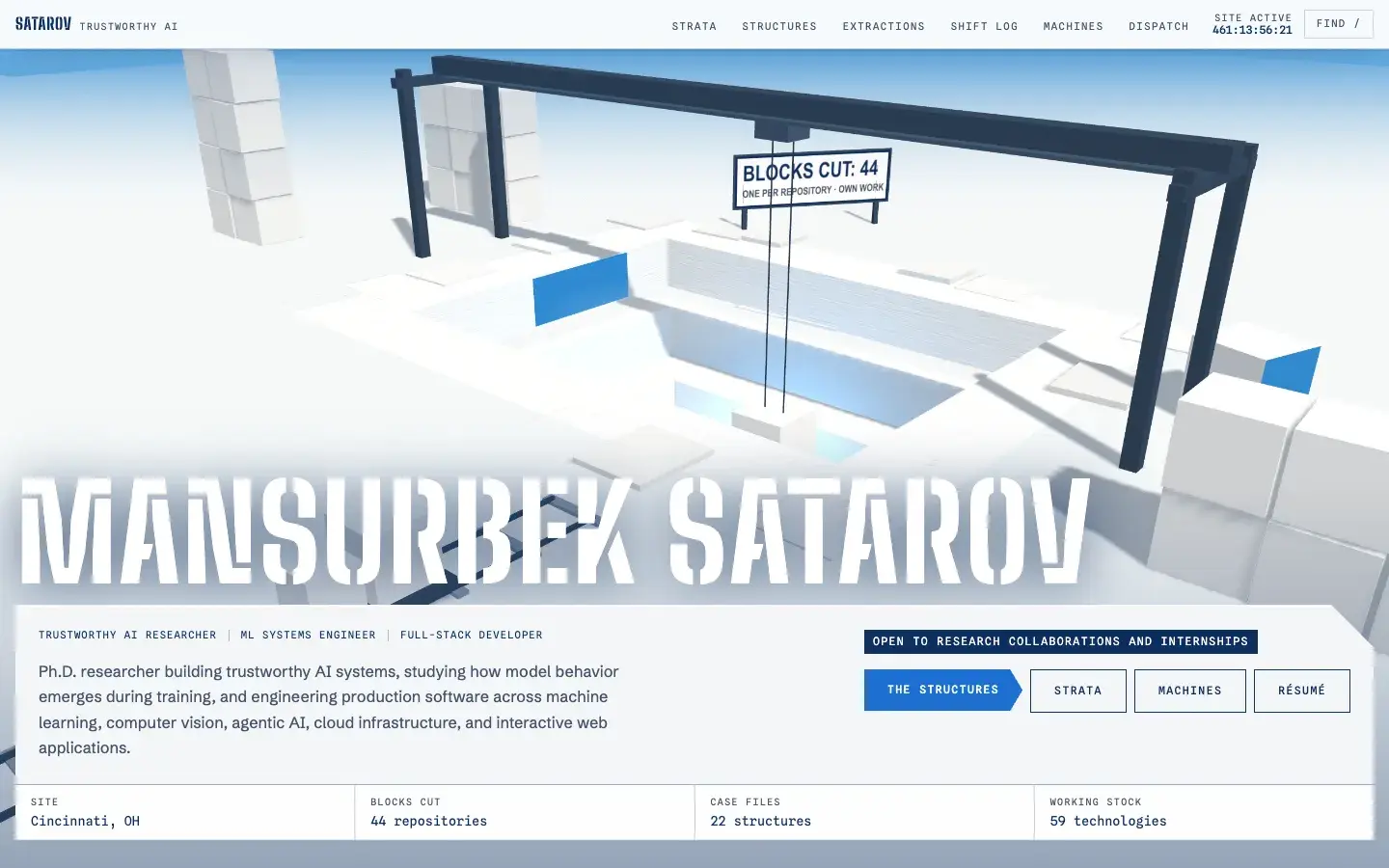
Cloud Quarry
v2 · 2026-10
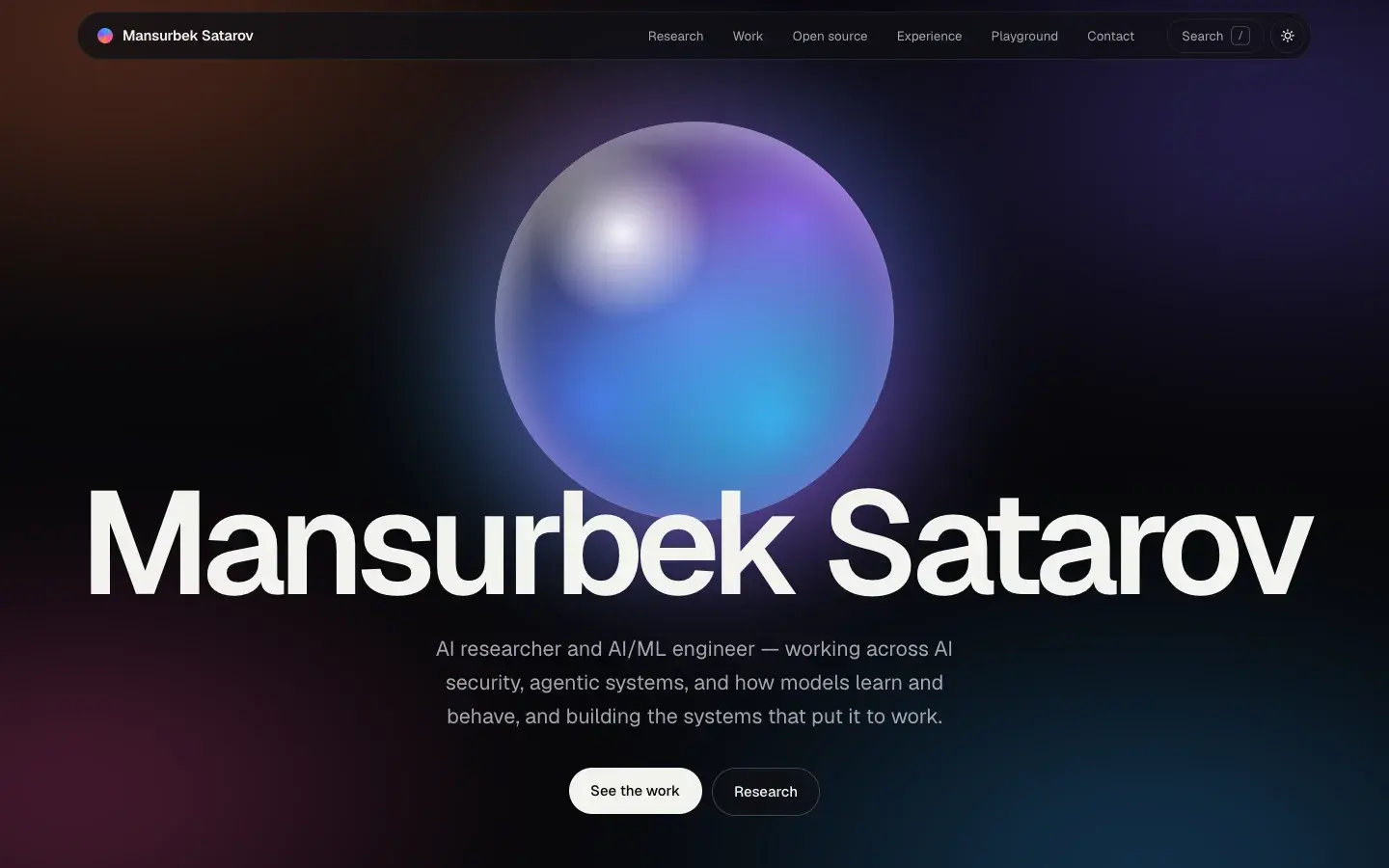
The Aligned Field
v3 · 2026-10
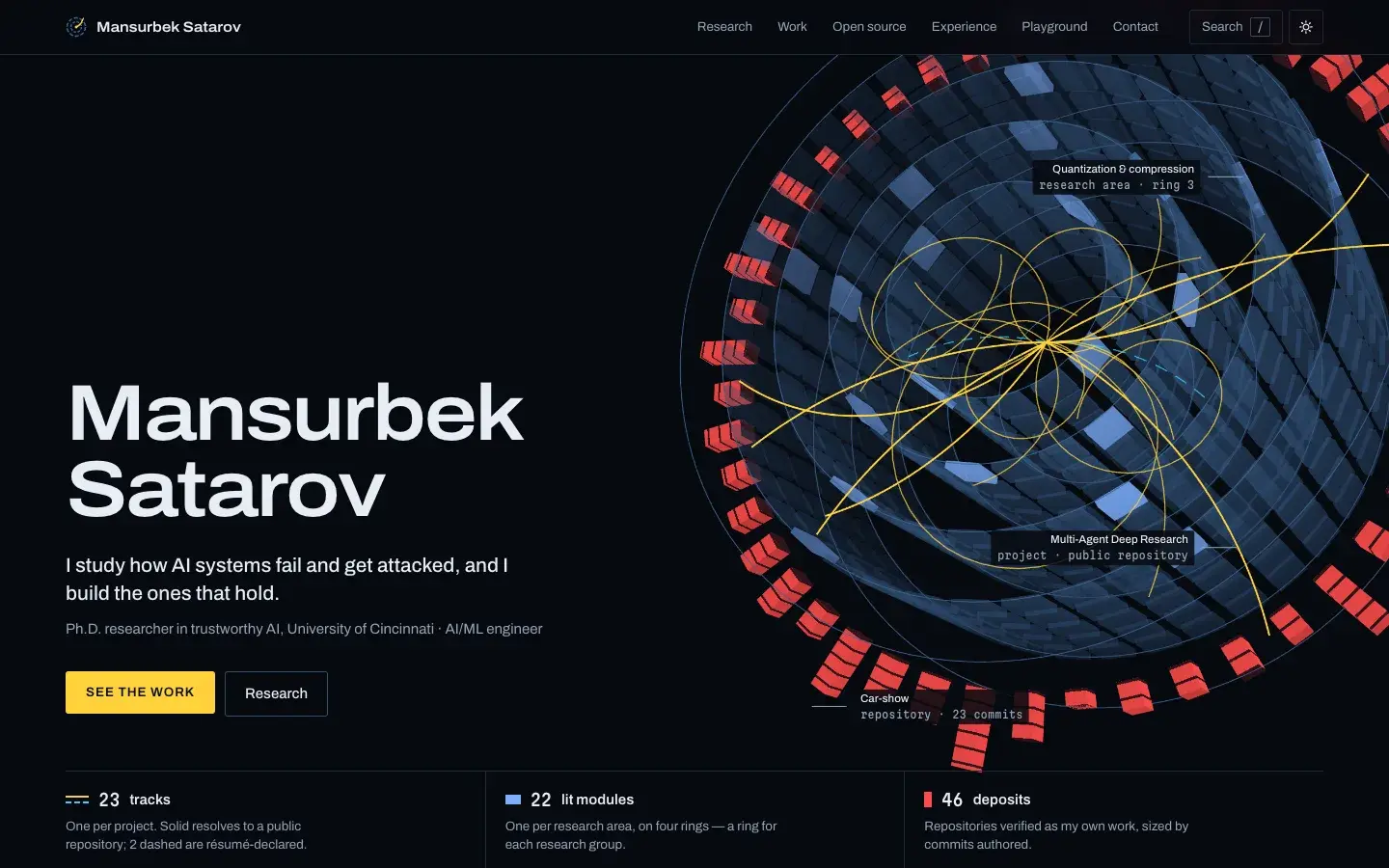
Event Displaynow
v4 · 2026-11
Let’s build something trustworthy
Research roles and collaborations, AI/ML and agent engineering, and systems that have to hold up. Replies usually within two days.
Open to research internships, research and ML engineering roles, and collaborations.